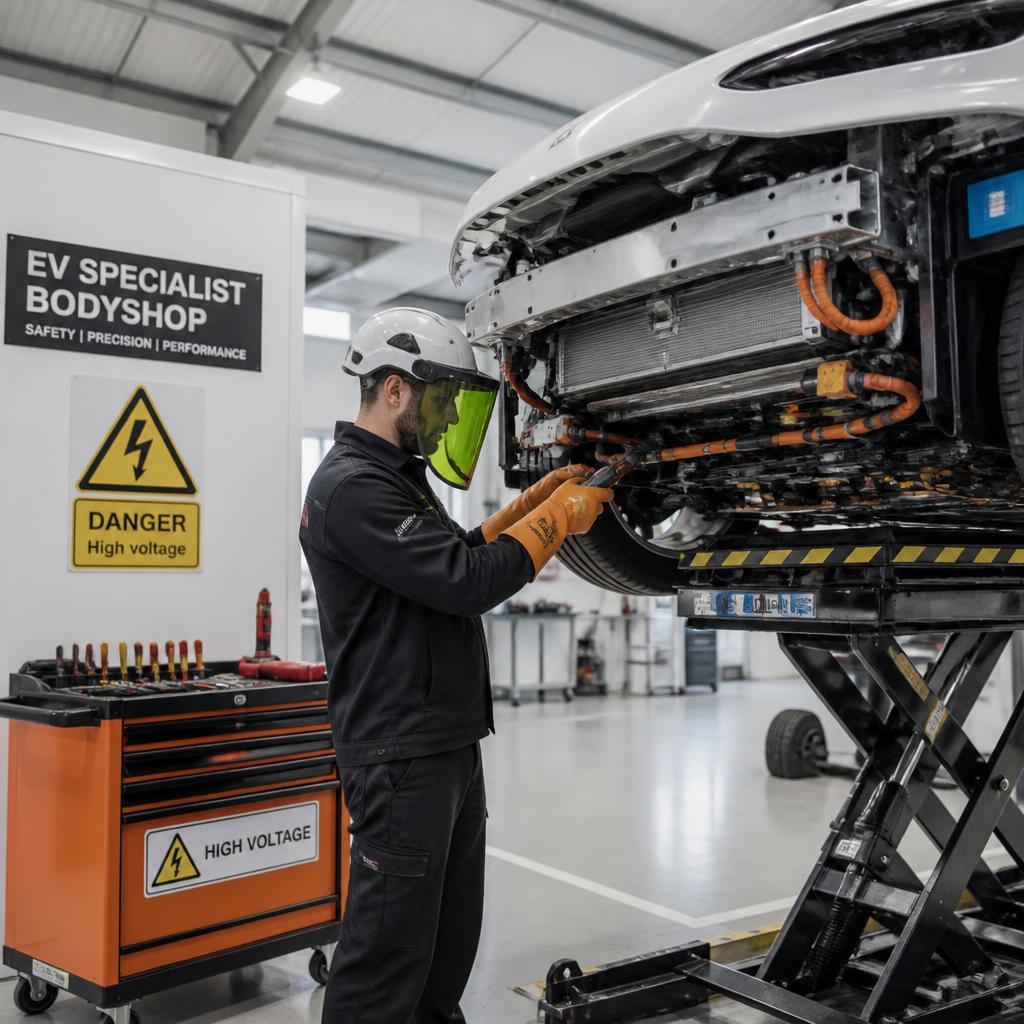
Can Electric Cars Be Repaired After an Accident? A UK EV Repair Guide
Yes, electric vehicles can be repaired after most accidents, but they need specialist bodyshops with high-voltage training, EV-approved equipment and ADAS calibration. Here is what to expect.
Yes. Electric vehicles can be repaired after almost any collision, but the work has to be done by a bodyshop with the right accreditations, tooling and high-voltage training. An EV is not a like-for-like swap with a petrol or diesel car once panels, structural rails or the underfloor battery pack are involved, and using the wrong repairer can invalidate the manufacturer warranty or, in the worst case, leave a damaged high-voltage battery unstable.
This guide answers the questions EV drivers, fleet managers and insurers ask us most often after a crash.
Why EV repairs are different
A modern electric car carries a 400V or 800V traction battery under the floor, dozens of ADAS sensors around the perimeter and structural aluminium or ultra-high-strength steel designed specifically to protect the pack. That changes three things about the repair:
- High-voltage safety: technicians must isolate and, where necessary, remove the battery before hot work, welding or structural pulling.
- Battery integrity checks: even a low-speed shunt can bruise a pack. Cell-level diagnostics and thermal imaging are used to rule out internal damage.
- ADAS recalibration: cameras, radar and lidar behind the windscreen, grille and bumpers have to be recalibrated to the manufacturer's tolerances after replacement or even a wheel alignment.
A general repairer without EV accreditation may complete the panel work, but skip the safety and calibration steps that keep the car reliable and insurable long term.
What the law and the standards say
In the UK, high-voltage work is governed by the Electricity at Work Regulations 1989 and by industry best practice from the IMI TechSafe register. BS 10125:2022, the standard your insurer's repair network is audited against, sets out requirements for EV and hybrid work under Annex A and expects the repairer to hold IMI Level 3 or 4 qualifications for anyone touching the high-voltage system.
That is why insurers route EV claims to a shortlist of approved sites rather than the nearest available bodyshop.
The five stages of an EV collision repair
- Safe intake and isolation. The car is moved to a dedicated EV bay, the 12V system is disconnected and the high-voltage system is de-energised using the manufacturer service disconnect. Only IMI TechSafe qualified technicians handle this stage.
- Battery pack diagnostics. Manufacturer-level scan tools read cell voltages, insulation resistance and thermal history. Thermal imaging is used to spot hot cells that pass an electronic check but are physically compromised.
- Structural and panel repair. Aluminium welding, rivet-bonding and sectioning are carried out to the OEM repair method, using the correct filler wires and torque specs. On some models the battery has to be dropped out before any body pulling can start.
- Reassembly and torque check. High-voltage cabling, orange safety loops and battery mounts are re-torqued to specification and insulation resistance is re-tested before the pack is re-energised.
- ADAS calibration and road test. Cameras, radar, lidar and 360 sensors are calibrated on a level, marked calibration floor. A road test with a diagnostic scanner confirms every driver-assistance feature is live.
Skip any of these stages and the car may drive away feeling fine but with lane-keep assist looking in the wrong place or a battery pack quietly degrading.
How long does an EV repair take?
Straightforward cosmetic work, such as a bumper skin or a wing, typically takes the same time as an equivalent petrol repair, around three to five working days once parts land.
Structural repairs or anything involving the battery tray add time because of the safety procedures, parts availability and the calibration slots at the end. Two to four weeks is a realistic guide for a moderate structural repair on a Tesla, Kia EV6, Polestar or ID range vehicle.
When is an EV written off?
Insurers will normally write off an EV if any of the following is true:
- The high-voltage battery pack is punctured, deformed or shows internal short-circuit warnings.
- Structural damage crosses the battery tray mountings on a skateboard-platform car.
- The economic cost of repair, including the new pack, exceeds the pre-accident value.
New battery packs are the single largest cost. That is why a proper post-impact battery diagnostic, done by an accredited bodyshop before the write-off decision is made, often saves an otherwise repairable car.
Choosing the right repairer
If your insurer gives you a choice, look for the following before you approve any work:
- IMI TechSafe registration and named EV-qualified technicians.
- BS 10125:2022 accreditation covering EV and hybrid work.
- Manufacturer approval for your specific brand where possible, particularly for Tesla, Polestar, Porsche Taycan, Audi e-tron and the newer Chinese EV brands.
- In-house ADAS calibration on a dedicated calibration floor, not sub-let to a third party across town.
- Courtesy EV if you rely on your car day to day.
Solution Repair Group's accredited network across the UK is built around these five requirements, which is why insurers, fleets and manufacturers route EV work to us.
What to do at the roadside after an EV crash
- Get everyone clear of the vehicle if there is any smell of coolant, smoke or a hissing sound from under the car.
- Do not touch any orange high-voltage cabling that is exposed after impact.
- Call your breakdown or insurer using the app or roadside number; ask specifically for an EV-trained recovery operator with a flatbed. Rolling recovery can damage the drivetrain on some models.
- Photograph the damage from all four corners and underneath if it is safe to do so.
- Ask for the car to be delivered directly to an accredited EV bodyshop rather than a holding compound where it may sit for weeks.
Frequently asked questions
Is it safe to drive an EV after a low-speed bump?
Only if the dashboard shows no high-voltage warning lights, there is no smell of coolant and the underfloor is visibly undamaged. If in doubt, do not drive and request an EV-trained recovery.
Will my warranty be affected by the repair?
Not if the work is done by a manufacturer-approved or IMI TechSafe accredited repairer following the OEM repair method. Warranty is usually voided only when unqualified technicians open the high-voltage system.
Do all bodyshops charge more for EV repairs?
Labour rates are typically higher because of the safety procedures and calibration, but this is offset by insurers routing EV work only to properly equipped sites. Getting the right shop first time is cheaper than a rework.
What about hybrids?
Plug-in and self-charging hybrids carry the same high-voltage system in miniature and follow the same safety rules. The IMI TechSafe qualification covers both.
Talk to an EV specialist
If you have been in a collision in an electric or hybrid vehicle, or you manage an EV fleet and want to know which of our sites are approved for your make and model, get in touch and we will route you to the nearest accredited repairer with EV capacity today.
Need Expert Car Accident Repair?
Find a trusted independent bodyshop near you through the Solution Repairs network.
Get a Free Quote